
Buying a home in Metro Vancouver is exciting, but if the property already has a tenant living in it, the deal becomes a little more complicated.
By the end of this guide, you’ll understand what it actually means to buy a tenanted property in BC, the difference between buying as an investor versus an owner-occupier, the notice periods and compensation rules under the Residential Tenancy Act (RTA), and the due diligence you should do before writing an offer.
Let’s dive in.
What Does Buying a Tenanted Property Mean?
Under BC’s RTA, a tenancy doesn’t end just because the property is sold.
Lease rights transfer if not handled properly
The lease and all of the landlord’s responsibilities transfer to the new owner at completion unless certain things are done, which means when you buy a tenanted home, you’re also inheriting the existing tenancy agreement, the rent amount, and the security deposit.
The tenant has the same legal protections under the new owner that they had under the previous one, and you become the new landlord the moment the deal closes. This is one of the most important things first-time buyers and new investors miss.
Why Are Tenanted Properties So Common in Vancouver?
In cities like Vancouver, Burnaby, and Richmond, it’s extremely common to see condos sold with a tenant in place, or detached homes where the basement suite is rented to help cover the mortgage.
High home prices and high rents both push more owners to rent out part or all of their property, which means a meaningful share of listings in Metro Vancouver come with a tenancy attached.
Discovering Potentially Tenanted Property During Your Home Buying Search
While it’s not required for sellers to list if they have a tenant or not, there are some indicators that can help you tell before you see the unit or learn more from the seller. This would include MLS descriptions that have:
- “24-48 hours notice required for showings” is a strong indicator — vacant homes don’t need notice
- Limited showing windows (e.g., only Tuesday evenings) suggest working around a tenant’s schedule
- Virtual tours only, with no in-person access
- Personal belongings, furniture that looks “lived in” but not staged
- Mention of rental income or current rent amount
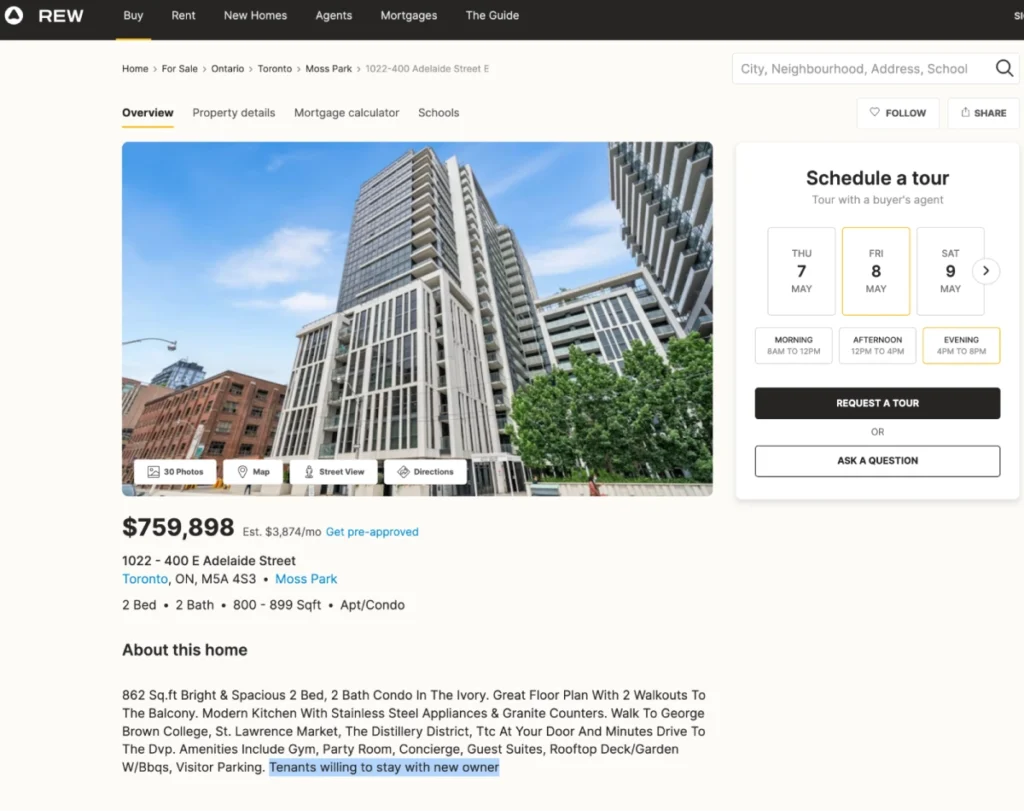
For example, this listing on REW specifically says in the description that their are current tenants, open to staying with ownership changes.
Fixed-Term vs Month-to-Month Tenancies
Keep in mind, if you have a tenant or are looking to purchase a tenanted property, not all tenancies are created equal, and the type of agreement in place will affect how much flexibility you have as the new owner.
Fixed-term tenancy
A fixed-term tenancy runs for a defined period, usually 12 months, with a specific start and end date.
Month-to-month tenancy
A month-to-month tenancy is open-ended and continues until either the landlord or the tenant ends it through proper notice.
In most cases under BC law, a fixed-term tenancy actually rolls over into a month-to-month tenancy at expiry, unless the original agreement included a specific clause requiring the tenant to vacate (and even those clauses are tightly limited under the RTA).
Why this matters
For buyers, this matters because a fixed-term lease may lock you in until the end date if the tenant intends to stay, while a month-to-month tenancy is generally easier to plan around.
Recommended Resource: Subjects in BC Real Estate: Definition, Removal, FAQ, and More
Buying a Tenanted Property in BC: Investor vs Owner-Occupier
The right approach depends entirely on what you plan to do with the home after closing.
Buying a Tenanted Property as an Investor
If you’re buying as an investor and you plan to keep the tenant, a tenanted property can actually be a strong advantage. You skip the hassle of finding a renter and you have a track record of the existing tenant’s payment history.
Additional responsibilities are assigned
A couple of technical details you’ll need to be ready for is that the security deposit is transferred to you at completion, and you now become responsible for returning it at the end of the tenancy. On top of that, the existing lease terms become your terms and the current rent becomes your rent.
A great Realtor will help you review the lease, line by line, and flag anything that doesn’t fit your plan before you waive subjects.
Buying a Tenanted Property to Live In
If you’re buying the property as your primary residence, the process is more involved and can involve longer timelines unless the current owner has taken the necessary steps a couple of months ahead.
Under section 49 of the RTA, a landlord can only end a tenancy on behalf of a purchaser if the buyer (or a close family member of the buyer) genuinely intends to occupy the home in good faith.
And to avoid confusion, a “close family member” under BC law is defined as the parent, spouse, or child of the buyer, or the parent or child of the buyer’s spouse. Siblings, grandparents, cousins, aunts, and uncles do not qualify.
The buyer must also intend to occupy the home for at least 12 months after the tenancy ends. This rule is basically designed to discourage buyers from using personal-use notices as a shortcut to vacant possession.
Example
A young couple in Burnaby bought a tenanted home and had the seller serve notice on their behalf. They then spent four months renovating before officially moving in — paying utilities at the new address but not actually occupying it. The former tenants applied to the RTB, and because the buyers missed the registered mail notices about the hearing, the case proceeded without them. They were ordered to pay around $25,000 (12 months’ rent) for failing to occupy within a reasonable period. Case: Fung & Cheung Burnaby case (2023 RTB decision) & News article.
Notice Periods and Tenant Compensation Under BC Law
Once a deal is firm — meaning all conditions of the sale have been satisfied — the buyer can ask the seller in writing to give the tenant a Notice to End Tenancy for Purchaser’s Use of Property.
Under the current rules, this notice requires 3 months’ written notice to the tenant, one month’s rent in compensation (typically credited against the tenant’s last month of rent), and a 21-day window during which the tenant can dispute the notice through the Residential Tenancy Branch (RTB). The notice must be generated using Form RTB-32P through the RTB’s online portal, not a handwritten or template letter.
The notice must be served by the seller (because the seller is still the landlord at the time the notice is given). The tenant also has the option to move out earlier and is still entitled to the full one month’s compensation.
A strategy for sellers
If you’re selling and want to make sure things will move quickly, you can provide this notice to your tenants when you make the MLS listing go live. This way, if the home takes 60 days to sell, the tenants will be out in 30 days for an easy possession date for the new buyer.
Keep in mind that these rules have changed multiple times over the past few years, so it’s worth confirming the current notice period and dispute window with your Realtor before you build your possession date around them. This isn’t legal advice, and the regulations can change.
What Happens If the Tenant Disputes the Notice
Tenants have the right to apply to the RTB for dispute resolution within 21 days of receiving a Notice to End Tenancy for Purchaser’s Use. If they file, the matter goes to a hearing and the timeline can stretch out by weeks, sometimes longer.
Example
A 2026 BC Supreme Court filing involving a property on East 10th Avenue in Vancouver shows how this can go wrong. A developer bought the home as part of a land assembly with vacant possession promised on closing. The seller exercised a rent-back option but kept the upper-unit tenants in place past the new possession date. The buyer was forced to step in as landlord, and shortly after, the City of Vancouver extended the Broadway Plan to the area, which triggered tenant relocation requirements the buyer had never planned for. Case: Sightline Properties v. Zhong & Cai (2026 BC Supreme Court filing, East Vancouver)
What If the Tenant Stays After You Buy
A common assumption is that once you’ve closed, the property is yours and the tenant has to be out. That’s not quite how it works.
If notice wasn’t properly served before closing, or if the tenant disputed the notice and the case is still pending, the tenant has every right to remain in the home under the existing tenancy. You, the new buyer, become the landlord and the lease continues as written.
How to Structure Your Offer on a Tenanted Property in BC
The offer is where the strategy really happens, and the right structure depends on your end goal.
If you intend to occupy the home yourself or have a close family member move in, your offer should include a subject clause giving you time to review the tenancy agreement and supporting documents, address vacant possession in writing (specifying who is responsible for serving notice and by what date), and set a completion and possession date that allows enough time for the full 3-month notice period plus a buffer for any disputes.
A Buyer’s Notice to Seller for Vacant Possession is the formal written request from the buyer to the seller, asking them to serve notice on the tenant after subjects are removed. It’s a key piece of paperwork in this scenario, and your Realtor can help you handle the timing.
Example
In a Lower Mainland case (Aulakh v. Nahal, 2017 BCSC 1000), a $2 million home with two tenanted suites collapsed at closing because nobody addressed the tenancies in writing. The buyer assumed vacant possession; the sellers assumed the buyer would keep the tenants. The Realtor, acting as a dual agent, left the standard vacant possession clause untouched. On possession day, the tenants were still there and the buyer refused to complete. The court found the sellers in breach of contract, with 25% liability also falling on the Realtor.
Recommended Resource: Title Insurance in BC: A Guide for New Buyers
Warning Signs When Buying a Tenanted Property in BC
Some tenancy situations are straightforward, and some are full of complications you don’t want to inherit.
Watch out for properties with:
- no written tenancy agreement,
- unclear deposit handling,
- a long fixed-term lease that conflicts with your move-in plans,
- existing RTB disputes or filings,
- unrealistic seller promises about vacant possession that aren’t backed by a properly served notice, or
- any discrepancy between what the seller says and what the lease shows.
When the tenancy situation is anything other than simple, get deal-specific advice from your Realtor, notary, or lawyer before you waive subjects.
Final Thoughts
Buying a tenanted property in BC isn’t a deal-breaker, but it’s a different kind of purchase than buying a vacant home. The Residential Tenancy Act strongly protects tenants, and as the new owner, you’re assuming legal responsibilities that begin the moment you close.
If you’re thinking about buying a home in Metro Vancouver and you’ve come across a tenanted property that interests you, we’d love to help you think it through before you write an offer. Contact us today and we’ll walk you through what to expect and how to structure a deal that works for your goals.
