
If you are planning to sell your residential property shortly after buying it, there is a rule in BC you need to understand, it’s called the BC home flipping tax.
This guide will help you understand what the BC home-flipping tax is, how the rules work, and ultimately what to expect if you plan to sell your newly purchased property within two years of the deal closing.
By the end of this article, you will have a clear picture of when this tax applies, what exemptions exist, and how it differs from federal tax rules, allowing you to move forward with confidence.
What Is the BC Home Flipping Tax?
The BC home flipping tax is a provincial tax levied on any profits made from selling a taxable residential property in BC if you have owned it for less than 730 days.
The main purpose behind this tax was to discourage short-term property speculation and help stabilize the housing market. However, there can be implications that can affect regular homeowners, not just investors or flippers.
For example, if you bought a townhouse in Richmond and then decide to sell it 18 months later because you want a bigger yard, you could be subject to this tax on the profit of that sale.
In short, the government looks at your timeline of ownership without the context as to why you purchased the property, so any short-term sale falls under scrutiny unless a specific exemption applies.
Recommended Resource: Selling Your Home Within a Year in BC: 7 Tips & Considerations
Who Does the BC Home Flipping Tax Apply To?
This tax was implemented to cast a wide net and is meant to apply to several different parties, including individuals, corporations, partnerships, and trusts. On top of that, BC residency is not needed for the tax to apply to your property.
So, even if you live in another province or country but sell a residential property in BC within 730 days of acquiring it, you are still subject to the rules.
Property Types
The kinds of properties this tax covers include standard residential properties, such as detached houses, townhomes, and condos. It also covers residentially zoned land, too.
Contracts & Assignments Are Included
As we mentioned earlier, this tax is quite wide-reaching. It also includes the rights to acquire property. This means presale contracts or assignments fall into this tax, which has been an important market for first-time home buyers, but also investors and landlords.
BC Home Flipping Tax Calculator
BC Home Flipping Tax Calculator
Estimate the provincial tax on properties sold within 730 days (2 years) of purchase, effective January 1, 2025.
This is an unofficial estimate for general information only — it is not tax advice. The calculator doesn’t account for the tax only applying to dispositions on or after January 1, 2025.
How the 730-Day Rule Works
The core of the BC home flipping tax is all about the two-year holding window. If a qualifying residential property is sold within 730 days of its acquisition, the tax may apply to any profits.
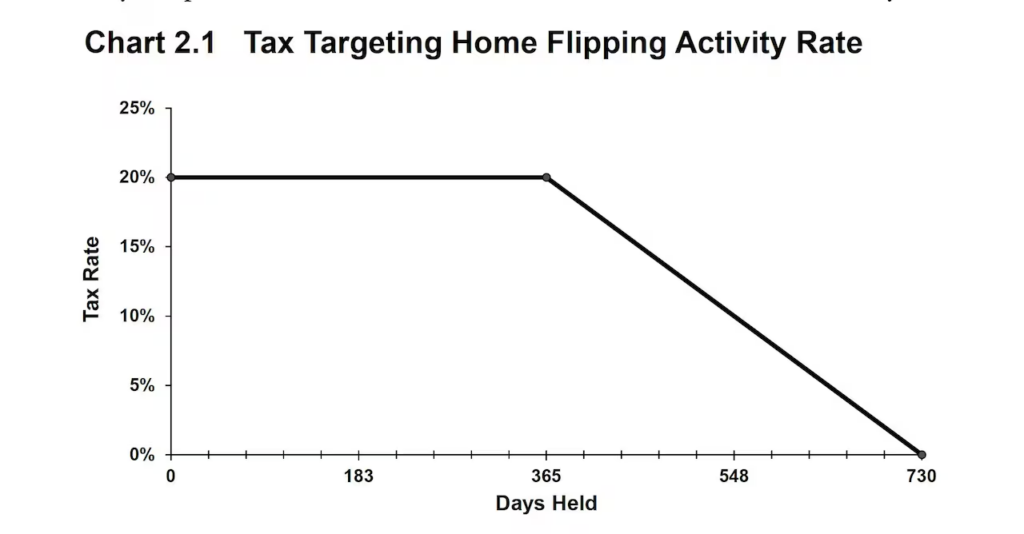
The tax rate is also not applied as a flat fee for the two years, though. Here’s how it works. It’s highest during the first year of ownership, then, after the first 365 days, the tax rate begins to decrease gradually over the second year. It continues to decline on a prorated basis until it reaches zero after day 729.
Once you have held the property for a full 730 days, this specific provincial tax no longer applies to your sale.
So, if you are considering selling in that 2nd year, you can find some relief in the fact that the taxes paid may not be as big a hit as you’re anticipating.
(Government of B.C.)
Key Dates: Acquisition vs Disposition
To figure out if you fall within the 730-day window, you need to know exactly when the clock starts and stops. To the government, what matters most is the date the property was acquired and the closing date (or completion date) on the title transfer.
Bought Before 2025? You May Still Be Affected
A very common mistake made by recent buyers is assuming this tax applies only to sales occurring on or after January 1, 2025. Beware, this is not correct!
If you bought the property before January 1, 2025, it’s still subject to the tax if it’s sold on or after that date and has been owned for less than 730 days. Keep in mind that this can be troublesome for potential buyers until late 2027.
How Much Is the BC Home Flipping Tax?
If you sell within the window, the tax is calculated based on the net taxable income from the sale, not the gross sale price of the home.
This means you are taxed on the profit only made after accounting for the original purchase price and allowable costs. So, it’s not an additional tax on the entire value, only profits are taxed.
So, if you sold within the first 365 days of ownership, the tax rate is a flat 20 percent on that net profit.
If you sell between day 366 and day 729, the 20 percent rate declines gradually to zero.
Simple Example Calculation
Let’s say you recently bought a condo and got an amazing deal in New West for $600,000. However, nearly ten months later, you sell the condo for $700,000.
To keep it simple, there were no deductions from the sale. So, your net taxable profit is $100,000. And because you sold within the first year, the BC home flipping tax rate is 20 percent.
Ultimately, you would end up owing $20,000 under this specific provincial tax. It’s an additional cost that gets added to all the other costs associated with selling.
Does the BC Home Flipping Tax Apply to Your Primary Residence?
Sorry to be the bearer of bad news, but the BC home flipping tax does apply to your primary residence if you sell it within the 730-day window.
The government offers a primary residence deduction of up to $20,000 against taxable profit, but it is not a full exemption. It’s meant to simply reduce the amount of profit that is subject to the tax, and it comes with specific conditions.
Primary Residence Deduction: What It Actually Means
In order to qualify for the primary residence deduction, you generally must own the property for at least 365 consecutive days and actually live in it as your primary residence during that time.
You cannot buy a home, live in it for three months, sell it, and expect to claim the deduction. As that would go against the purpose of this tax and how it’s supposed to curb investors from flipping properties during a seller’s market.
Do Presales and Assignment Sales Count?
If you have a presale contract and are looking to do an assignment sale, yes, you’ll still be considered under taxable property from this home flipping tax.
And keep in mind that this 730-day window begins from the date of the contract signing, not at the completion date when the building is finished.
Exemptions to the BC Home Flipping Tax
While the rules are strict, there are situations where you can sell within two years without paying the tax.
Common Life Circumstance Exemptions
While this tax can be a hassle, the government recognizes that life is unpredictable. Practical life-event exemptions exist for situations that force a homeowner to sell earlier than planned. These include significant events such as job loss, serious illness, death, divorce or separation, foreclosure, and expropriation.
Additionally, there are a couple of specific exemptions designed for builders, developers, and owners who are completing substantial renovations that add to the housing supply, though the criteria for these are very specific.
Gifted or Inherited Property
Finally, if you receive a property as a gift or inherit it from a family member and want to sell, it’s not automatically outside the tax rules. How the property was acquired and the timeline of the previous owner can affect whether an exemption applies to you if you decide to sell it quickly.
However, these exemptions are not automatic. In many cases, you must actively file a return to claim them.
Do You Need to File a BC Home Flipping Tax Return?
If you’re within that 730-day window, get ready for some more paperwork. You will need to file tax paperwork related to this home flipping tax.
The BC home flipping tax return is entirely separate from your annual income tax filings with the Canada Revenue Agency (CRA).
If you sell a qualifying property within the 730-day window, you must generally file this specific provincial return within 90 days of the sale’s completion date.
What Happens If You File Late?
This deadline window is not something you want to miss either. If you file the return late, you can be hit with penalties and interest on the amount owed. We recommend speaking with your notary, lawyer, or accountant before you sell to ensure you have all your paperwork and money lined up.
BC Home Flipping Tax vs. the Federal Property Flipping Rule
It is easy to get confused between provincial and federal rules, especially since both governments have recently cracked down on property flipping. The BC home flipping tax is a separate provincial regime. The federal property flipping rule, managed by the CRA, generally applies to sales within 365 days of purchase. Under the federal rule, profits from a flipped property are treated entirely as business income rather than capital gains.
The most important thing to know is that both sets of rules can apply to the exact same sale.
Recommended Resource: Can You Negotiate Realtor Fees in BC? [Here’s How]
Lower Mainland Scenarios: When the BC Home Flipping Tax May Come Up
To put this into perspective, let’s look at a few realistic situations relevant to homeowners in Metro Vancouver:
Selling a Burnaby Condo Early
You buy a starter condo in Burnaby. After 14 months, interest rates change, and your monthly payments become unmanageable, so you decide to sell. Because you sell before 730 days, the provincial tax applies. Since you owned it for more than 365 days and lived in it, you may qualify for the $20,000 primary residence deduction, and the federal flipping rule may no longer apply.
Assigning a Surrey Presale
You sign a presale contract for a townhome in Surrey. 18 months later, before completion, the market jumps, and you assign the contract to a new buyer for a $50,000 profit. Because the assignment happens within 730 days of signing, the BC home flipping tax applies to your profit, and no primary residence deduction is allowed.
Relocating for Work
You buy a house in North Vancouver. Eight months later, your employer permanently relocates your job to Toronto. You sell the house to move. In this scenario, you would likely qualify for an employment relocation exemption, but you must still file the 90-day return to claim it.
Frequently Asked Questions
Does the BC home flipping tax apply if I live in the home?
Yes. Living in the property does not automatically remove the tax. However, a primary residence deduction of up to $20,000 may be available to reduce your taxable profit if you lived there and owned the home for at least 365 consecutive days.
Do I have to file a return if I qualify for an exemption?
In most cases, yes. Some exemptions still require a separate return to be filed within 90 days of the sale, while a few highly specific ones do not. You should always consult a tax professional to confirm which rules apply to your exact situation.
Does the BC home flipping tax apply to presales and assignments?
It certainly can. Presale contracts are considered taxable property. The 730-day holding period begins on the day the presale contract is signed, not the day the building is completed.
What is the difference between the BC home flipping tax and the federal flipping rule?
The BC tax covers the first 730 days of ownership as a separate provincial tax on profits. The federal rule generally covers the first 365 days and treats the entire profit as business income for your federal taxes. Both rules can apply to the same sale.
Other Government & Organizational Resources
- BC home flipping tax – BC Government
- BCREA – What To Know About BC Home Flipping Tax
- File a return for the BC home flipping tax
Final Thoughts
Remember that exemptions exist for major life events, but they require proper documentation and timely filing. Because this provincial tax can overlap with federal property rules, having the right guidance is incredibly important.
If you are considering selling a property you have owned for less than two years, contact us today and see how we can help you navigate your early home sale.
